The Life, Legacy, and Mind of Chief Dr. Victor Omololu Sowemimo Olunloyo
VOSO Forever is the official digital archive dedicated to preserving the life, work, and enduring legacy of Chief Dr. Victor Omololu Sowemimo Olunloyo – statesman, scholar, mathematician, and one of Nigeria’s most distinguished minds.
QUINTESSENTIAL VOSO – HIS LIFE & TIMES
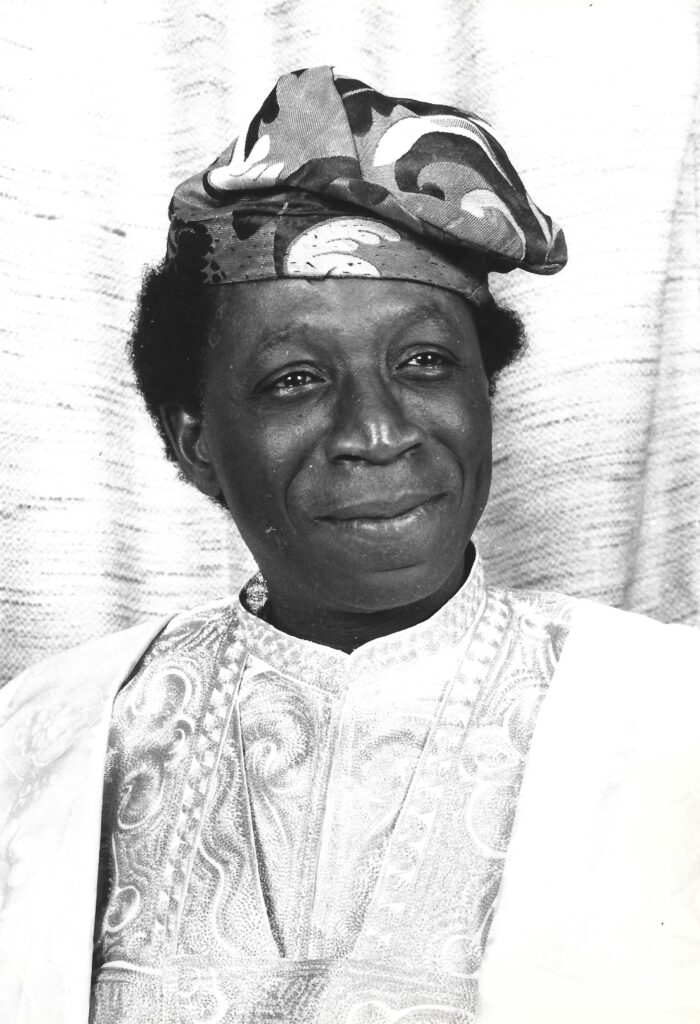
No comet was seen on that fateful day. In fact, the day could have passed as ordinary but for the fact that it was a Sunday and a market day. It was 14 April 1935, when the infant who would later in life re-define academic brilliance, political sagacity, and cultural leadership was born. He was not exactly born with a silver spoon, but he sure had a pedigree; being born a scion of the legendary Olunloyo family of Oke-Oluokun compound, Kudeti, Ibadan. Victor Omololu Sowemimo Olunloyo was born to his erudite father, Horatio Vincent Sowemimo; a scholar, musician, civil servant, trade unionist, and church man; and to his influential mother, Tejumola Abebi Olunloyo, a trader and women leader. Even as a child, the young Victor was said to have been precocious, demonstrating unusual abilities that often astonished those around him. Early in life, Victor had the privilege of travelling for a few months to Enugu with his father, Horatio, who was then on government transfer. That trip opened Victor’s consciousness to the plurality of the Nigerian state. His experience would leave him with a deep appreciation and love for the Igbo people of Eastern Nigeria. There and then, his pan-Nigerian fervour was forever born.
By 1939 after returning with his father to Lagos on another official duty post, Victor was enrolled at the Holy Trinity School, Ebute-Ero. Holy Trinity was the first of four schools he went in succession for his primary education. From Holy Trinity, Victor was transferred to Methodist School, Olowo-gbowo, then to Ibadan due to the breakdown of his parents’ marriage. At Ibadan he was enrolled at St. Peters’ Primary School, Aremo by his great Uncle Akingbehin Olunloyo, who was a Priest and the Headteacher at the school. Upon his uncle’s transfer, young Victor followed him to Gbongan, where he was enrolled at St. Paul’s Primary School. It was at Gbongan that he took the common entrance examinations in 1946 and in 1947. By now, Victor’s brilliance gene was beginning to manifest as he came first both years throughout the entire Ibadan District Church Council extending as far as towns such as Iwo, Ikirun, and Osogbo. That was how his primary school education came to a glorious end.
In 1948, after a rigorous process, Victor Omololu was admitted to the great Government College Ibadan (GCI), with his GCI number 546. It was at GCI that the seed for his great academic achievements was nurtured. After an initial academic setback that landed Omololu in 23rd position in his class, he leapt to 4th, and from then on, there was no looking back till he passed out from GCI as a foremost member of his distinguished set, in academics and sports. Omololu was one of the best ever cricket bowlers to have passed out of Government College Ibadan. A very interesting feat of the cricket team in his time was beating the King’s College Lagos team home and away in 1952 after King’s College had previously beaten GCI five years in a row between 1947 and 1951. Omololu was a GCI scholar. He was a legend whose brilliance shone brightly in those years and henceforth. Other members of his illustrious class included Akinkugbe, Bankole, Lekan Are, and Muyiwa Awe. By October 1953, Omololu had gained admission into the University of Ibadan. Three months later in December of the same year he had passed the Inter-BSc program which was designed to run for two years. Omololu’s stay in UI was facilitated by two scholarships – the Western Regional Government scholarship and the Production Board scholarship. The same year, he was appointed by the late Pa Emmanuel Alayande to teach Mathematics and Additional Mathematics at Ibadan Grammar School where he (Alayande) was then the Principal. The same Pa Alayande and Pa Soyele were instrumental in Victor receiving his scholarships.
Omololu passed the 1954 Cambridge overseas Higher School Certificate in flying colours and was exempted from the Intermediate Degree of the University of London, for which he was preparing. In June of 1958, he graduated with a First Class Honours Degree in Mechanical Engineering. He also won the Final Year and Honours year’s Mechanical Engineering medals, as well as mathematics class medals in each of the 1955/56, 56/57, 57/58 sessions. Interestingly, Omololu once scored 132% out of 100% in an examination. In 1958, he was also awarded the British Association (1939) prize for the most distinguished student in the Faculty of Science at Queen’s College, University of St Andrews. That award had not been won by anyone at the University for 11 long years. Due to his exceptional academic performance, Victor transferred from Mechanical Engineering to Applied Science, where he continued to break records. One such record was winning five gold medals out of a possible six – quite unprecedented. Omololu soon caught the attention of the British monarchy and was guest of Queen Elizabeth II at Buckingham Palace, where he was honoured for his many brilliant academic feats. One of the greatest testaments to Victor Omololu’s exceptional brilliance and flair for Mathematics, was that he was exempted from the BSc and MSc in Mathematics and allowed to proceed straight to his PhD in Mathematics at the same University. He subsequently completed his PhD in two years. His thesis, ‘On the numerical determination of the solutions of Eigenvalue problems of the Sturm-Liouville type’, broke many new academic grounds.
On February 1, 1961, Dr. Victor Omololu Sowemimo Olunloyo joined the University of Ibadan as an Assistant Lecturer and by May 5 of the same year, he was already promoted. Over the next four years, he earned the rank of Lecturer Grade 1. Soon after this feat, Omololu was yet again appointed as Senior Lecturer. At that time, the University College, Ibadan had no Faculty of Engineering, so Omololu taught Mathematics, logic, and abstract algebra. In between, Omololu Olunloyo worked briefly with the University of Ife, then returned to Ibadan. Some of his most notable university students were Ajibola Ogunshola (Punch Newspaper), Pastor W. F. Kumuyi (Deeper Life Bible Church), Sunday Ehindero (former Inspector General of Police), and Olu Layinka (the first female COREN registered engineer in Nigeria who later married Engineer Vincent Maduka, the first Director General of the NTA). He also taught late Major General Omojokun (ex-NYSC Director General), Tersil from Plateau, and Adepoju from Ogbomoso. From available records, Dr. Olunloyo also taught at least four people who worked at the National Aeronautics and Space Administration (NASA) in the United States.
In 1962, at the age of just 27, Dr. Olunloyo became the first ever Commissioner for Economic Planning and Community Development (Western State) with the immediate task of conducting the 1963 census. He also had a brief stint as Commissioner for Special Duties in 1967. His performance in those posts opened more doors of public service to Dr. Victor Omololu Olunloyo. Hence, between 1967 and 1969 he served as Commissioner for Education. By 1st of January 1971, he served two portfolios concurrently: Commissioner for Local Government & Chieftaincy Affairs, and Commissioner for Education in the old Western State. His tenure as Commissioner for Education remains unsurpassed till today. It was on that beat, in the then Oyo State, that he introduced many revolutionary ideas and programs that directly improved quality on one hand, and access to education on the other. In what became a dress rehearsal for his future leadership roles, Victor Omololu, as Honourable Commissioner for Local Government & Chieftaincy Affairs, resolved the long-standing dispute on the appointment of Alaafin Lamidi Adeyemi. He resolved equally long-standing disputes in Ife, Modakeke, Ogbomoso, Ilara-Mokin, Igbara-Oke, etc.
When The Polytechnic, Ibadan was founded in 1970, Olunloyo served as its pioneer Rector. He passionately gave expression to the vision of the founding fathers of the institution. To underscore this vision, Olunloyo built the road linking the North and South campuses of the Polytechnic in just one day, using in-house staff, materials, and hands. Later, he also served as Rector at Kwara State Polytechnic, Ilorin. His next public assignment was as Chairman of the Property Development Corporation of Oyo State, where he introduced dynamic changes and opportunities, eagerly contributing to the state’s development in a meaningful way. One of the most notable projects of his tenure was the Agbowo Shopping Complex, which stood as a symbol of progress. He was also responsible for building and selling residential homes, including bungalows in Alabiamo and Aperin Streets, as well as other areas of Bodija. Immediately after that, he served as Chairman, Ajoda New Town Development Corporation where he continued to apply concepts in property management and urban planning. His next public service role was as Executive Secretary of the National Science and Technology Development Agency (NSTDA) from 1978 to 1979. He continued to rigorously push for reforms and advancements in Nigeria’s educational and scientific sectors.
After many years of distinguished public service through appointments under various governments, VOSO threw his hat into the ring to contest for the coveted seat as Executive Governor of old Oyo State. He won, in an election whose effect reverberated across the entire country, Nigeria. Unfortunately, just as he was settling down to the business of governance to deliver his lofty ideals in education, social, economic, and infrastructural development of a dimension never seen before in the political annals of Nigeria, the military coup of December 1983 truncated that ambition. As a committed and passionate public servant, Olunloyo refused to be discouraged by the coup, he later served as member of the National Defence Committee of the National Constitutional Conference in 1994-1995, and as a member of the Transition Implementation Committee in 1995-1998. He served as Board member including ex-officio of over 40 Federal and State parastatals, Board member of each wholly owned Western Nigerian Development Corporation (WNDC) company in the then Western State, as well as Board member of all 22 National Research Institutes throughout Nigeria between 1978 and 1980.
Dr. Olunloyo was a foundation member of the National Institute of Policy and Strategic Studies (NIPSS) in Kuru, the Nigerian National Merit Award Board of Trustees, as well as member of the Western State Scholarship Board, Federal Scholarship Board, Continuation Committee Rehovot Conference in Israel, Commonwealth Scholarship Panel, and Commonwealth Science Council. He served as Chief Examiner at WAEC (Add Maths), External Examiner at the University of Ghana in Legon, and as External Examiner at the University of Benin all between 1963 and 1976. Omololu Olunloyo was a member of both the Council for the Regulation of Engineering in Nigeria (COREN), and of the Nigerian Society of Engineers; a Fellow of the Nigerian Institute of Science and Technology; and a Member of each of the Edinburgh Mathematics Society, American Mathematics Society, and the Mathematics Association of Nigeria. As a way of appreciating his service and community leadership, Olunloyo was honoured with many chieftaincy titles including Bobajiro of Ibadanland, Bobasewa of Ile-Ife, Amuludun of Omuo-Ekiti, and Obateru of Idanre. He was also decorated as Balogun of Oyo Empire. In the year 2000, and in recognition of Dr. Victor Omololu Sowemimo Olunloyo’s contributions to the educational and social development of Nigeria; he was conferred with the prestigious National Award in the category of Officer of the Order of Niger, OON.
Chief Dr. Victor Omololu Sowemimo Olunloyo passed in the early hours of April 6, 2025, at the age of 89. He left a huge legacy and will be dearly missed. May perpetual light shine upon him, Amen!
Written by: Dr. Kayode Adejumo-Bello
Official Biographer to Dr. Omololu Olunloyo